
When Algorithms Become Products: Rethinking Liability in the Age of Social Media
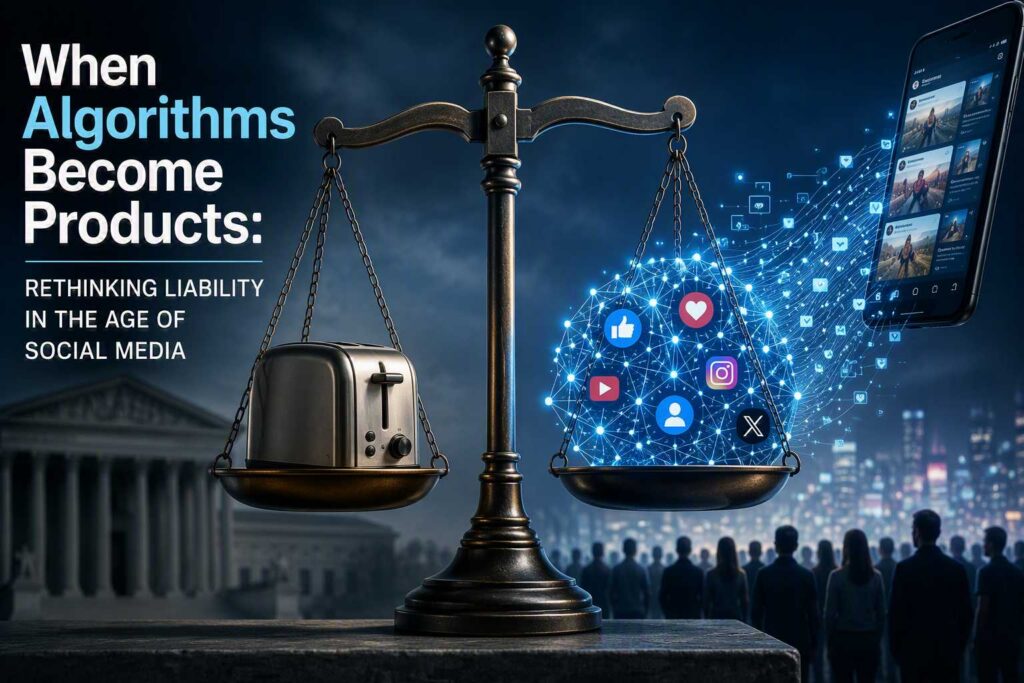
by Alberto P. Cosio & Daniela Prizont-Cado
The most consequential unresolved question emerging from the recent wave of social media liability cases is deceptively simple: what duty of care, if any, governs algorithmic systems? Increasingly, courts are being asked to decide whether platform algorithms are merely neutral tools responding to user demand or engineered products whose design choices carry foreseeable psychological harm.
New research comparing social media use to tobacco litigation is neither accidental nor superficial. In the 1990s, tobacco cases turned a corner once courts and juries accepted that cigarettes were not simply a matter of consumer choice but were deliberately engineered to promote addiction. At that point, the legal inquiry shifted away from personal responsibility and instead toward product design, corporate knowledge, and foreseeable harm. Social media litigation may be following a similar trajectory. Plaintiffs are reframing algorithmic systems not as passive conduits of content, but as psychologically engineered mechanisms designed to exploit dopamine-driven feedback loops and maximize user dependence.
Tobacco companies ultimately faced liability not because smoking was dangerous in the abstract, but because they knew their products were addictive, marketed them aggressively to minors, and concealed or denied the science for decades. A resulting settlement agreement in 1998 forced sweeping changes: billions in payments to states and significant restrictions on marketing practices, fundamentally reshaping the industry.
Today’s social media cases are testing whether analogous principles apply to digital products. By characterizing features such as infinite scroll, personalized recommendation algorithms, and engagement loops as affirmative design choices, plaintiffs are pushing courts to assess whether those features are reasonably safe or instead constitute negligent or defective design. The legal question is no longer whether users choose to engage, but whether platforms have a responsibility to avoid designs that predictably cause harm, particularly to minors and psychologically vulnerable users.
In late March of 2026, a Los Angeles jury found both Meta and Google liable for designing addictive platforms for young users, awarding $3 million in compensatory damages and another $3 million in punitive damages—opening the door to a much broader legal challenge for tech giants. If these claims continue to survive motions to dismiss and result in jury verdicts, their impact will extend well beyond damages awards. Social media companies could be forced to reassess core engagement mechanics that have long been treated as untouchable, especially where internal research or external evidence suggests a disproportionate risk to youth mental health.
At the same time, these cases raise difficult line-drawing problems. Where does lawful optimization end and negligent design begin? Which features represent permissible efforts to improve user experience, and which cross into the territory of foreseeable psychological harm? Courts have not yet answered these questions definitively—but verdicts begin to supply practical answers.
The challenge is compounded by the structure of the U.S. legal system. For decades, Section 230 of the Communications Decency Act and First Amendment defenses provided platforms with a relatively uniform national shield, allowing companies to operate under consistent legal assumptions across jurisdictions. Product liability law, however, is largely state-driven. As claims are increasingly framed in negligence and design defect—rather than speech—platforms may find themselves subject to a patchwork of state standards.
That fragmentation carries real operational consequences. Companies may be forced either to engineer jurisdiction-specific versions of their products to comply with differing state liability regimes, or to adopt a single, more conservative national design standard calibrated to the most restrictive jurisdictions. Either approach would require substantial engineering, compliance, and business-model adjustments.
Furthermore, the significance of these cases lies less in any single verdict than in their cumulative effect. As courts grapple with algorithmic design through the lens of traditional tort principles, a new baseline may begin to emerge: a legally enforceable duty of care for algorithmic systems. Much like tobacco litigation before it in the late 1990s, social media liability law may ultimately redefine modern times, not just accountability after harm occurs, but how products are designed in the first place.
